

Beginning in the fall of 2026, the school will introduce a new hybrid block schedule designed to change the rhythm of the school day while providing more opportunities for academic support, activities, and student formation.
The revised schedule will include seven class periods along with a new daily Magis period, which school leaders say will help students connect more intentionally with clubs, academic resources, and formation programs during the school day. Dean of Students Mr. Beigie said the schedule change followed extensive discussion among many members of the school community.
“This is specific to us, with a lot of conversation that has taken place with teachers, other stakeholders, and administration… It was determined that this was not only the right model, but the right time for us to hopefully better meet the needs of all of you to prepare you for your future.”
According to a Frequently Asked Questions (FAQ) document released by the principal’s office about the new schedule, the change comes after several years of evaluation and community feedback. School leaders studied scheduling models used at other Jesuit and local schools while gathering input from students, parents, and faculty before selecting the hybrid approach.

The new structure blends elements of a traditional daily schedule with longer class periods. Students will meet with each teacher four out of every five school days, attending 42-minute classes on Mondays, Tuesdays, and Fridays and extended 76-minute periods on Wednesdays and Thursdays, which administrators say allows for deeper discussion, collaborative work, and hands-on learning activities.
The revised schedule will also slightly adjust the school day. Classes will begin at 8:10 a.m. and end at 3:00 p.m. In addition, Thursdays will feature a delayed start at 9:30 a.m., allowing time for faculty collaboration and planning.
Some students have already pointed out potential benefits of the change. Junior Joey Ma said, “The only thing I really like about the new schedule is that there’s going to be a delayed start every Thursday. That’s pretty cool. I also think there may be less homework overall because teachers might give us more time to do it in class.”
Administrators say the adjustments respond in part to feedback requesting more intentional time during the school day for student formation, connection, and well-being while still meeting academic requirements.
Not all students are convinced the change will be beneficial. Sophomore Ava Papalardo said she worries the slightly later dismissal could worsen traffic for student drivers.
“I don’t like it because I think that the people that are driving are gonna be stuck in a lot worse traffic than we already have. And, in my opinion, the extra 10 minutes isn’t really gonna do much or add much to our day,” Papalardo shared.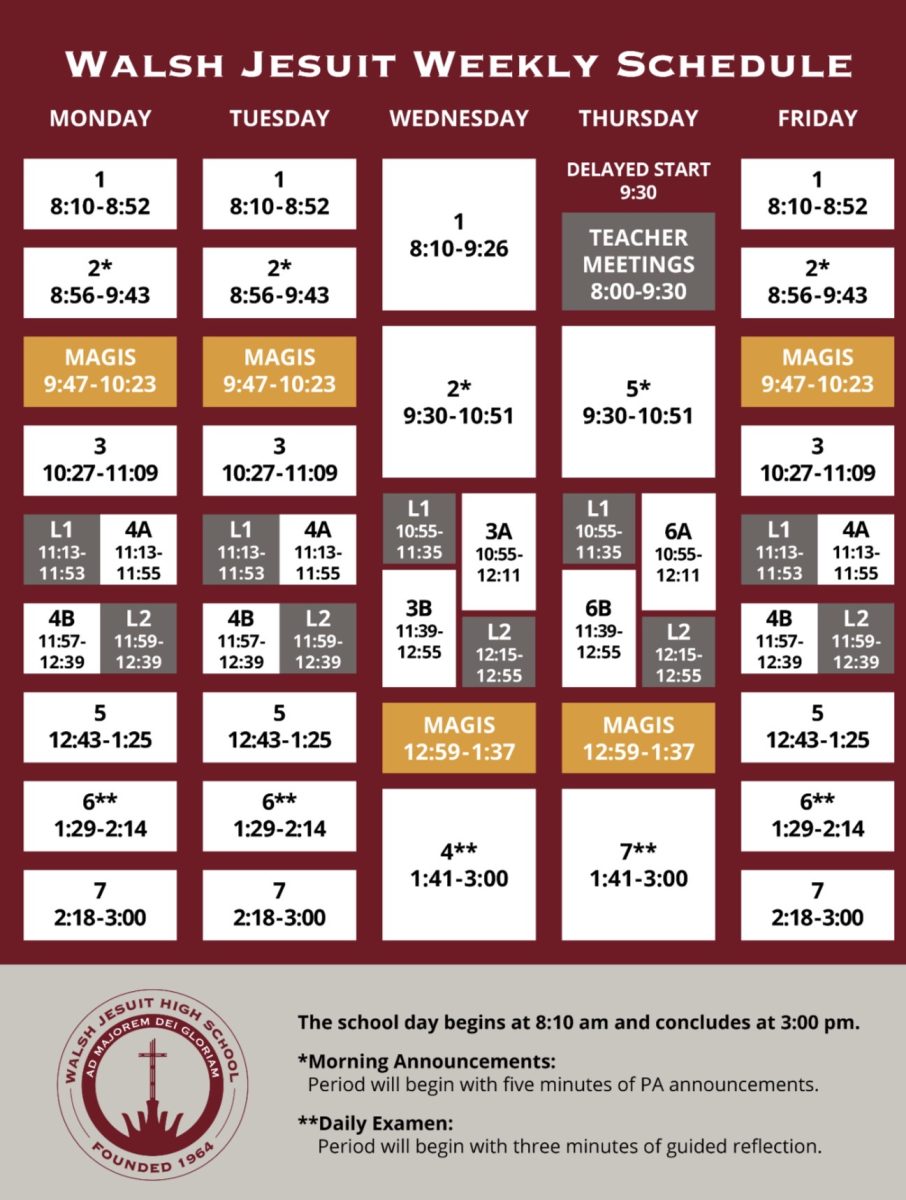
Some students also expressed concern about the longer class periods. Freshman Carter Lohan said extended blocks may make it harder for students to stay focused.
“I don’t think the block periods would be very beneficial. After a certain point in the day, when you’ve been in a certain subject for time, you just get tired of it, and you can lose focus and daydream, and that’s when you don’t really learn anything. So, I think being in a class for over an hour can have real negative effects on the learning experience,” Lohan said.
Sophomore Ava Papalardo added, “there will be some days where you have a class a lot more than another class, and I think that the learning is just gonna be unbalanced.”
One of the most significant additions to the schedule is the Magis period. The word magis, a Latin term commonly used in Jesuit education, means “more” or “greater.” School leaders say the period will create intentional time for experiences beyond traditional classroom instruction.
“By formalizing a Magis period, we’re going to have the opportunity to better engage all of the spectacular work that’s being done in student experience that can happen outside of school time, the next steps of academic support, the clubs, the activities, and all that fun stuff,” Mr. Beigie said. “With that, we’re trying to bring that into a consistent time for more students to be engaged,” he concluded.
According to the principal’s office FAQ, the Magis period may include club meetings, mentoring programs, grade-level formation activities, meetings with teachers or academic support staff, and opportunities for reflection and community engagement.
Junior Brody Mineard said the period could give students a chance to explore activities they might not otherwise try.
“I like the idea of doing something new and checking out different clubs. That could be interesting.”
However, some students remain skeptical about how the time will actually be used. Junior Kendra Catanzarite said she worries the period could become unproductive if students are not given a clear structure.
“I don’t want to have a free period every day; it will be too much free time that will be abused instead of used effectively. I think once a week would be good for the students,” Catanzarite said.
Administrators say the school is already preparing teachers for the transition to longer class periods. Faculty members were surveyed about the types of support they may need, and this semester’s professional development is focused on helping teachers design lessons that work effectively within the extended class blocks.
“I think it’s a good idea because it gives students choice,” President Tim Grady said. “It’s a change, and sometimes change is hard, and we think, ‘Oh, I don’t like change, so therefore I don’t like this.’ But I think if people give it a chance, they’ll actually find it to be kind of cool.”












Lisa Baylor • Mar 11, 2026 at 1:07 pm
Very timely article. Thanks for your multiple perspectives. Well written.